From Bedroom to Arena: Why Your First Vocaloid Concert Might Feel Totally Overwhelming (And How to Handle It)
You've spent years with Hatsune Miku living inside your earbuds. You know the BPM of your favorite tracks by heart. You've cleared Expert mode on Project DIVA more times than you can count, and your YouTube history is basically a shrine to producer discography deep-dives. Vocaloid has always been your thing — intimate, personal, available on demand.
Then you walk into a venue for the first time, the lights drop, and… something feels off.
You're not alone. A growing number of fans are showing up to their first live Vocaloid events and experiencing a kind of culture shock that nobody really talks about. It's not that the show is bad — it's that the experience is so radically different from everything that shaped your relationship with this music that your brain genuinely doesn't know how to process it. Let's break down what's actually happening and how you can close that gap.
The Headphone Generation Problem
Vocaloid fandom, more than almost any other music community in the US, was built in private spaces. You discovered Miku through an algorithm recommendation at midnight. You fell in love with a producer's catalog while studying or gaming alone in your room. The music arrived through a screen, curated to your taste, playable at whatever volume felt right.
That listening environment trains your brain in specific ways. You develop expectations around sound quality, pacing, and control. You can pause. You can rewind. You can look up lyrics mid-song without missing anything. Live concerts strip all of that away in one go, and the adjustment can be genuinely jarring — even for people who are deeply passionate fans.
This isn't a personal failing. It's just what happens when a generation of digital-native fans encounters an analog, communal experience for the first time.
The Uncanny Valley of Miku's Live Voice
Here's a specific thing that catches a lot of first-timers off guard: hearing Miku's voice through a massive PA system sounds different from the recordings you've internalized. Not worse, necessarily — just different in ways that can feel disorienting.
In your headphones, Miku's voice is crystalline, perfectly balanced against the production. In an arena, that same voice bounces off concrete walls, gets colored by room acoustics, and competes with subwoofers rattling your chest. Some fans describe it as a kind of uncanny valley moment — close to what they know, but shifted just enough to feel unfamiliar.
This is completely normal, and it actually fades pretty quickly once you give yourself permission to stop comparing the live experience to your saved playlists. The live version isn't trying to be the recording. It's its own thing. Letting go of that comparison is honestly one of the biggest mental unlocks for enjoying a Vocaloid concert.
Crowd Dynamics Are a Whole Skill Set
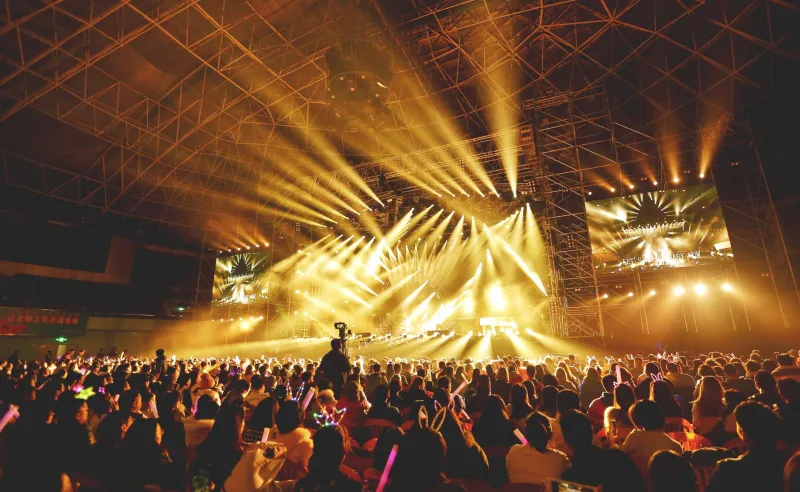
If most of your Vocaloid consumption has been solo, the crowd at a live show can feel overwhelming in ways that go beyond just noise levels. There's the physical closeness of general admission floor sections. There's the synchronized light stick waving that looks incredible in videos but requires actually knowing the color calls in advance. There's the communal chanting, the call-and-response moments, the unspoken etiquette about when to move and when to stay put.
For fans who found Vocaloid as a solitary comfort — and a lot of us did — suddenly being surrounded by hundreds of other people doing the same thing can trigger a weird mix of emotions. Belonging and overstimulation at the same time. Joy and anxiety running parallel.
A few things that genuinely help:
Arrive early and get your bearings. Walking into a half-empty venue before the crowd fills in gives you time to figure out the layout, find your section, and mentally settle before the energy ramps up.
Learn the light stick basics beforehand. MikuEvent's own coverage of past concerts can walk you through the color call conventions. Knowing what to do with your hands makes you feel like part of the crowd instead of an observer.
Give yourself an exit plan. Not because you'll necessarily need it, but because knowing you can step out for air if things get too intense is enough to keep anxiety from spiraling. Most venues have lobby areas where you can hear the show without being in the thick of the crowd.
The Social Pressure of Being a "Real" Fan
There's another layer to this that doesn't get talked about enough: the fear of being perceived as not knowing enough. Vocaloid fandom has a deep, sprawling knowledge culture. Longtime fans can rattle off producer aliases, release histories, and remix lineages without blinking. Walking into a concert as someone who mostly knows the big hits can feel intimidating.
Here's the thing though — live events are actually one of the most welcoming entry points into fandom, not the most gatekept. People at concerts are there because they love the music. When someone's glow stick is the wrong color or they don't know the chant for a deep cut, the overwhelming majority of the crowd isn't judging. They're just vibing.
If you're nervous about your fandom credentials at a live show, that anxiety is almost certainly louder in your head than it is in the room.
Practical Ways to Bridge the Gap Before You Go
The best thing you can do to prepare for your first Vocaloid live event is to start shifting some of your listening habits before the show. Here's what actually makes a difference:
- Listen on speakers instead of headphones at least occasionally in the weeks before. It starts retraining your ears for room sound.
- Watch full concert footage on YouTube — not clips, but full sets. Let yourself sit with the pacing, the transitions, the crowd noise. Treat it like a preview.
- Join a local fan Discord or subreddit and ask if anyone else is going to the same show. Having even one person you've talked to before the event changes the social dynamic completely.
- Look up the expected setlist if spoilers don't bother you. Knowing what's coming reduces the cognitive load and lets you actually feel the songs instead of spending energy figuring out what's playing.
The Shift That Makes It Click
Every fan who goes through this adjustment period tends to describe the same turning point: there's a moment — usually somewhere in the middle of the set — where the comparison to your bedroom listening experience just... stops. The crowd is doing its thing, the lights are going, and you're suddenly just in it.
That moment is different for everyone. For some people it's the first time the bass hits a drop they know by heart. For others it's when the crowd around them sings along to a song they thought was obscure. For some it's just exhaustion lowering the mental guard enough to let the experience land.
It will happen. And when it does, it reframes everything that came before it — including all those years of private, headphone-deep fandom that got you to that room in the first place.
Vocaloid was always meant to connect people. It just took a while for the live experience to catch up with how the music found most of us. Now that it has, it's worth showing up for — even if the first hour feels a little weird.